
Written by Cristeta Lagadan
Photographs courtesy of Cristeta Lagadan
BAGUIO CITY – On July 25, 2026, the University of Baguio School of Criminal Justice and Public Safety (SCJPS) conducted the Recollection for Class Salig-Dangal 2026 at the Audio-Visual Room (AVR), University of Baguio, for a recollection that went beyond skills training to touch the very heart of their future vocation. Guided by the reflective theme “Who Am I?”, the activity invited every participant to pause amid preparations, look inward, and examine the authentic self that will stand behind every decision, action, and interaction they will carry out in service to the public.
The session opened with uplifting songs of praise and fellowship, filling the room with warmth and unity and setting a reverent yet welcoming space for honest reflection and sharing. Leading the recollection was Bro. Julius F. Kitong, a proud alumnus of the UB School of Criminal Justice and Public Safety (SCJPS). He unpacked how societal expectations, worldly pressures, personal desires, and misleading influences can distort self-perception, erode moral principles, and pull individuals away from their true purpose and core convictions. Beyond naming these challenges, he offered practical, faith-rooted ways to stay grounded: regular self-examination, steadfast prayer, and intentional alignment with one’s values so that interns may remain discerning, resilient, and unwavering in integrity even in the most demanding and high-pressure situations.
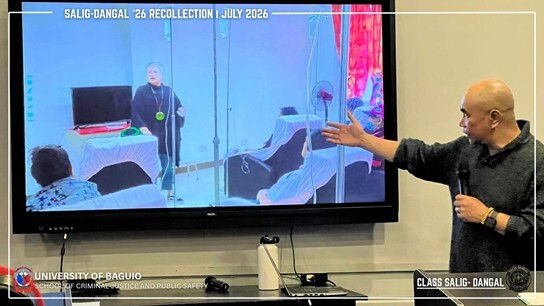
The recollection gained greater meaning and emotional depth through firsthand testimonies that resonated with the student interns as future practitioners in criminal justice and public safety. Bro. Julius F. Kitong shared his formative journey of self-discovery, recounting how he had once measured his identity and personal worth through titles, responsibilities, accomplishments, and the opinions of others. He explained that relying on external recognition eventually led him to examine his life more deeply. Through honest self-reflection and a renewed relationship with God, he learned to look beyond temporary labels and rediscover an identity grounded in faith, dignity, and a greater sense of purpose. His testimony reminded the interns that genuine fulfillment does not come solely from professional success or public recognition, but from knowing who they are, recognizing their inherent worth, and allowing their values and faith to guide their decisions.
PCol (Ret.) Davy Vicente M. Limmong, a respected SCJPS faculty member and veteran of public safety service, further enriched the gathering by drawing from decades of professional and personal experience. He recounted moments of danger, uncertainty, hardship, and personal struggle that tested his courage, judgment, and commitment to duty. Throughout these challenges, he found strength and direction through unwavering faith and constant prayer. These became his sources of courage, discernment, humility, and moral clarity, enabling him to remain faithful to his vocation and committed to protecting the welfare of the people he served. His testimony demonstrated that public safety service is more than a profession; it is a calling that demands integrity, resilience, compassion, selflessness, and steadfast devotion, especially during the most difficult circumstances.
The gathering concluded with a solemn period of collective worship and a closing prayer of blessing. This meaningful conclusion provided the interns with an opportunity to express gratitude, reflect on the lessons shared, and renew their commitment to their faith, personal values, and future responsibilities. The recollection left Class Salig-Dangal 2026 spiritually renewed and united, carrying a clearer understanding that their identity must remain firmly rooted in faith and character, while their purpose must be reflected in responsible, ethical, and compassionate service to others. As they prepared to enter their respective internship assignments, the interns were reminded that the strength of their calling would be measured not only by what they accomplish, but also by the integrity, humility, courage, and concern for others that they demonstrate throughout their journey.
The formative activity is deeply aligned with the Sustainable Development Goals (SDG), embedding holistic human development into the interns’ professional preparation, targeting that nurtures emotional balance, spiritual strength, and inner peace, fostering the mental and emotional resilience indispensable for those entering high-stakes public service roles where sound judgment and composure are critical. The activity also supports SDG 4.7, which integrates character formation, self-awareness, and moral discernment into professional training, ensuring that academic and technical competence is always paired with conscience, empathy, and a strong sense of ethical responsibility. More than that, it supports SDG 16.5 and 16.6: just, trusted, and accountable institutions are built on the character of their people. By strengthening personal integrity and moral discernment, the recollection lays the foundation for future practitioners who will uphold impartiality, transparency, and respect for the rule of law. It is also guided by SDG 17.17, which embodies purposeful collaboration, bringing together alumni mentors, seasoned faculty, and future practitioners in a cycle of guidance and knowledge-sharing, proof that meaningful growth is best achieved when generations stand together toward a shared vision of service.
For Class Salig-Dangal 2026, this gathering was more than a spiritual exercise; it was a reminder that service is never just a set of procedures or competencies. It is a living extension of one’s identity, rooted in integrity, anchored in faith, and dedicated to upholding the inherent dignity of every person. The recollection affirmed that before one can lead communities, uphold the law, or represent public institutions, one must first know oneself so that every act of service rendered will be done with purpose, sincerity, and the enduring pride of the Filipino public servant.